

How to make more time
No really, I’m asking.

Last month — my busiest billing month of the year, one that was also packed with family birthdays, a preschool break, work travel, a trip with friends, and Halloween’s multiple costumed outings — I somehow managed to spend three days alone in a tiny house in the North Georgia mountains. I had no agenda other than to write.
The house was bare-bones, a true definition of “tiny,” and the rental fee was reasonable compared to other places nearby. I drove there and back on less than a tank of gas. On my first night, I made a big pot of pasta and ate it for lunch and dinner the rest of the trip — a frugal move, if not a balanced one (by day three, my stomach was not happy). I left the property only once, to hike at the stunning Tallulah Gorge State Park (entrance fee: $5).
On paper, the trip was affordable — I could have spent just as much during a full weekend at home. Still, it felt extravagant. Lavish. Abundant. I was rich with the thing I lack most: time.
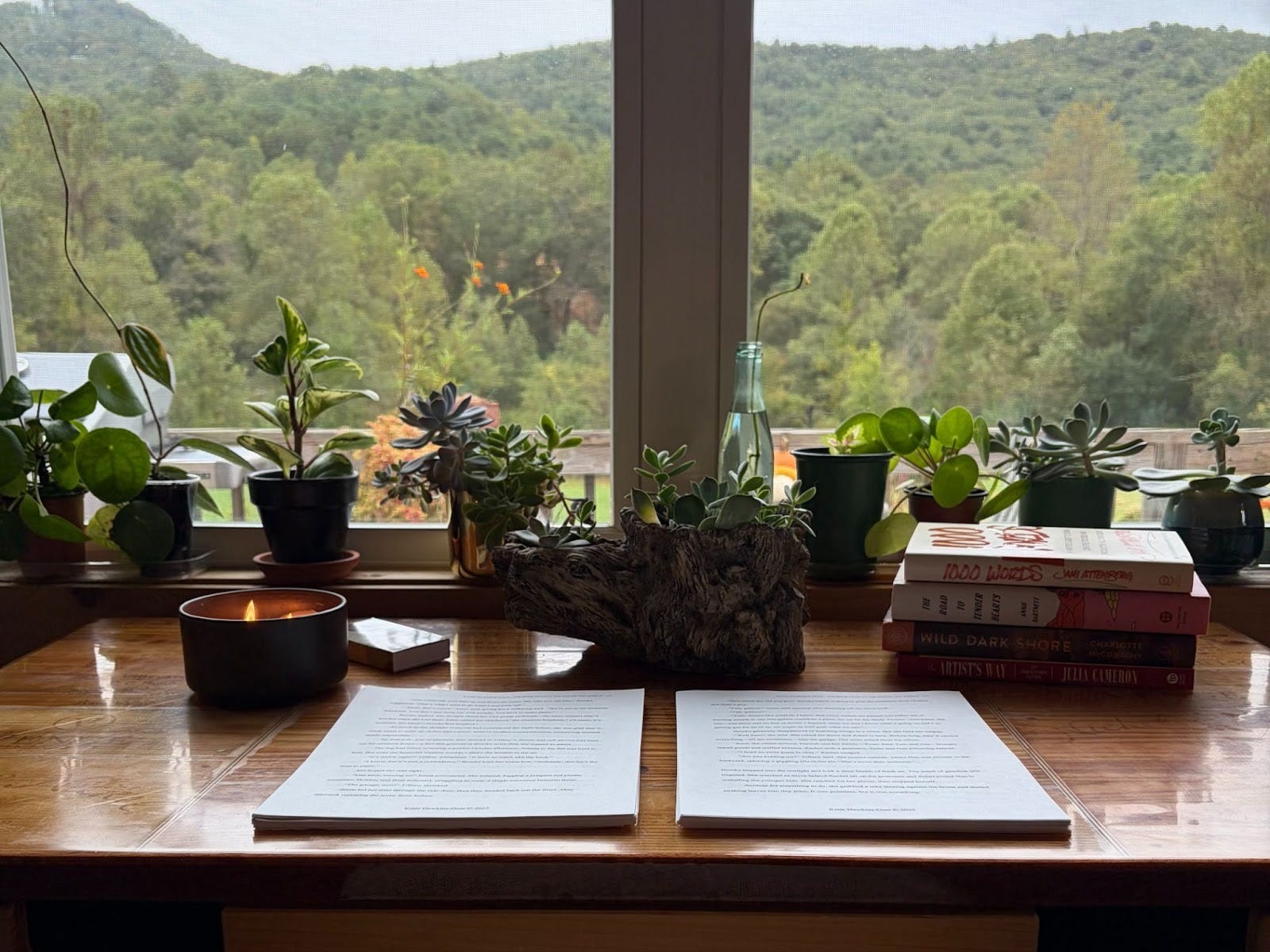
The first morning, I woke early, eager to take advantage of all the hours stretching out ahead of me. I brewed a pot of coffee before sunrise and started my day reading in bed, a luxury I rarely get at home. Then, as the outline of the mountain ridge began to take shape in the distance, I settled in to write.
I brought my manuscript with me. My novel-in-progress. My wannabe book that, the longer time stretches on, the more embarrassed I feel to mention. What began as a rough first attempt written in a fast-paced, ambitious haze last November is now in its second or third revision — a draft that too often sits in the proverbial drawer, an effort I increasingly struggle to make time for.
In July, I received my first rejection letter. I’d sent the manuscript to an agent I’d been in touch with previously, after she’d expressed interest in my nonfiction writing. After a few agonizing weeks, she replied. Her note, unlike the friendly responses before, was brief: it was a “fun premise,” she said, but she didn’t know how to position it in the marketplace. She wished me luck and sent me on my way.
I’ve read enough writing books, listened to enough publishing podcasts, and spoken with enough writer friends to know that this is a rite of passage. If I really want to get my book out there, I should expect many, many more rejections before finding an agent willing to take me on. I know that what doesn’t work for one agent might resonate deeply with another.
Still, her response crushed me. Not because of the rejection itself, but because I knew I’d rushed things. I’d felt so time-poor — so worried that my hopefully good idea, my “fun premise,” might lose relevance — that I sent her a version I wasn’t proud of. I hadn’t meaningfully incorporated outside feedback or even given myself a full, careful read-through. Instead, I sent a draft that had been hastily edited in stolen pockets of time between other obligations.
So I set the manuscript aside. I leaned into the busy-ness of summer travel and back-to-school. Said yes to more freelance work. Questioned whether I really wanted to subject myself to the heartbreak and time-suck of trying to publish a book.
For a while, the break felt good. But as the weather cooled and routines settled, the itch to write returned.
I listened to that urge. I shifted some deadlines, blocked off a few days, found a place to stay, dug my manuscript out from under a pile of stuff in a closet, second- and third-guessed the decision, and — with some strong encouragement from Billy, who knows the struggle of being strapped for time — drove up to Clayton, Georgia.
Finally, there I was, with nothing but time on my side.
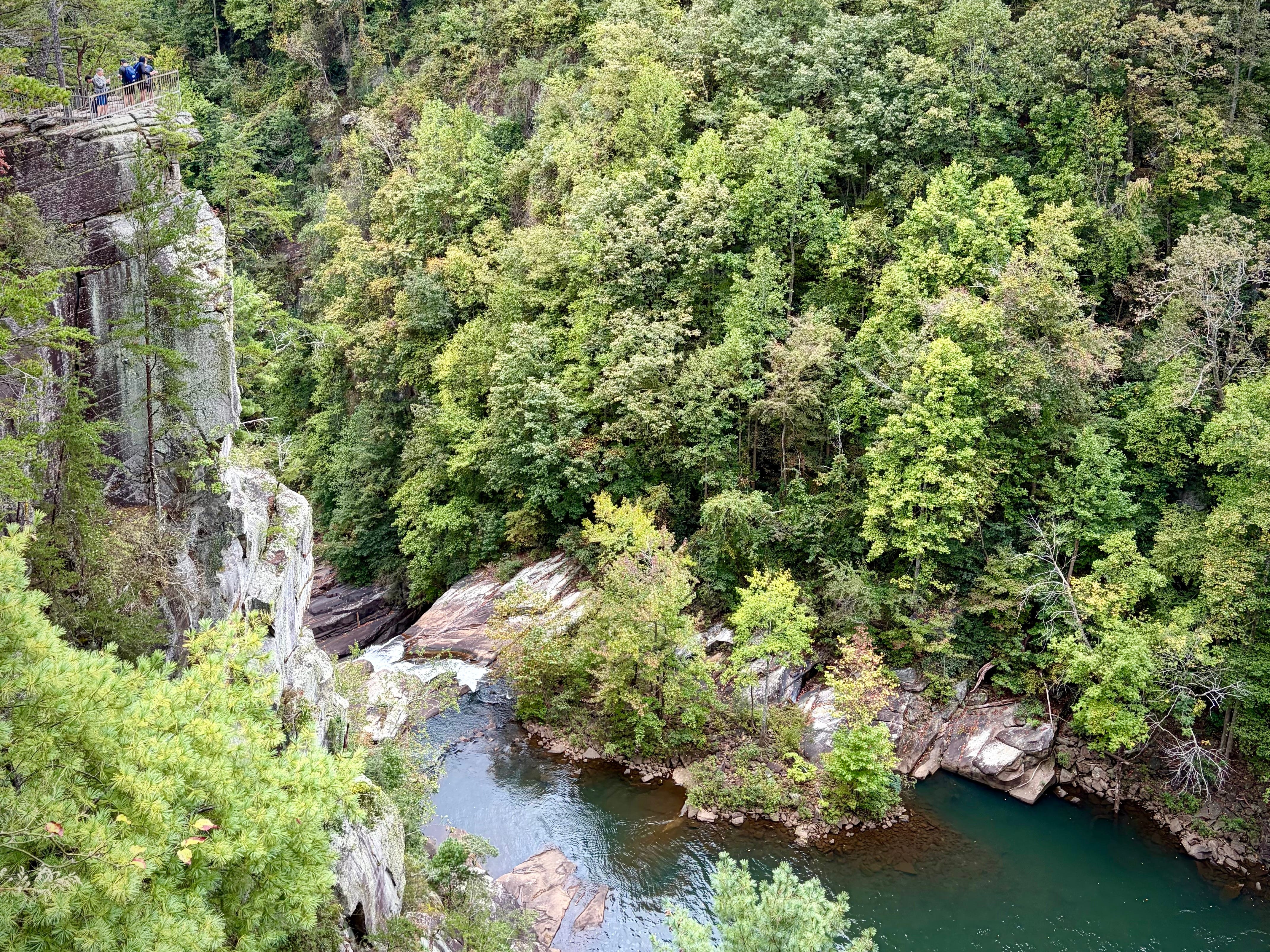
Before taking the trip, I decided not to set any ambitious goals. As tempted as I was to optimize my time, I also wanted to enjoy the abundance of it. I didn’t want to feel like I was working against a running clock. So I set one intention: to determine if I still liked the book — and if I wanted to keep writing it.
Fortunately, I did. By the end of the second day, I remembered what I loved about the story, and cringed at how rough the manuscript still was. I read chapters out loud, paced outside as I thought through plot challenges, and read an entertaining 400-page novel, start to finish. I had a breakthrough on a structural problem I’d been stuck on. I only checked email a couple of times. I gave myself the gift of going slow.
During those three days in the mountains, I revisited and revised four of my 49 chapters. It wasn’t much, but I felt proud of what I’d accomplished.
I returned home refreshed and rejuvenated. Ready to continue writing! But the moment I settled in, the abundance of time I enjoyed in Clayton had evaporated. I faced a heavier-than-usual workload and busier-than-usual social calendar. All good things — except when it comes to working on a novel that no one’s waiting for but me. Finding time to write is difficult, and it’s almost always interrupted by my child, my partner, or the ping of another meeting notification.
I can see how easy it would be to let it all slide — to lose sight of the motivation and clarity I found in the mountains. But I don’t want to. That time was a privilege, and it felt great. I don’t want it to amount to so little.
This weekend, like most weekends, I had to make tough choices about how to spend my limited hours. On Saturday, before a family hike, I opened my Word document and continued revising. I made it through half a chapter. Again, not much, but it felt good.
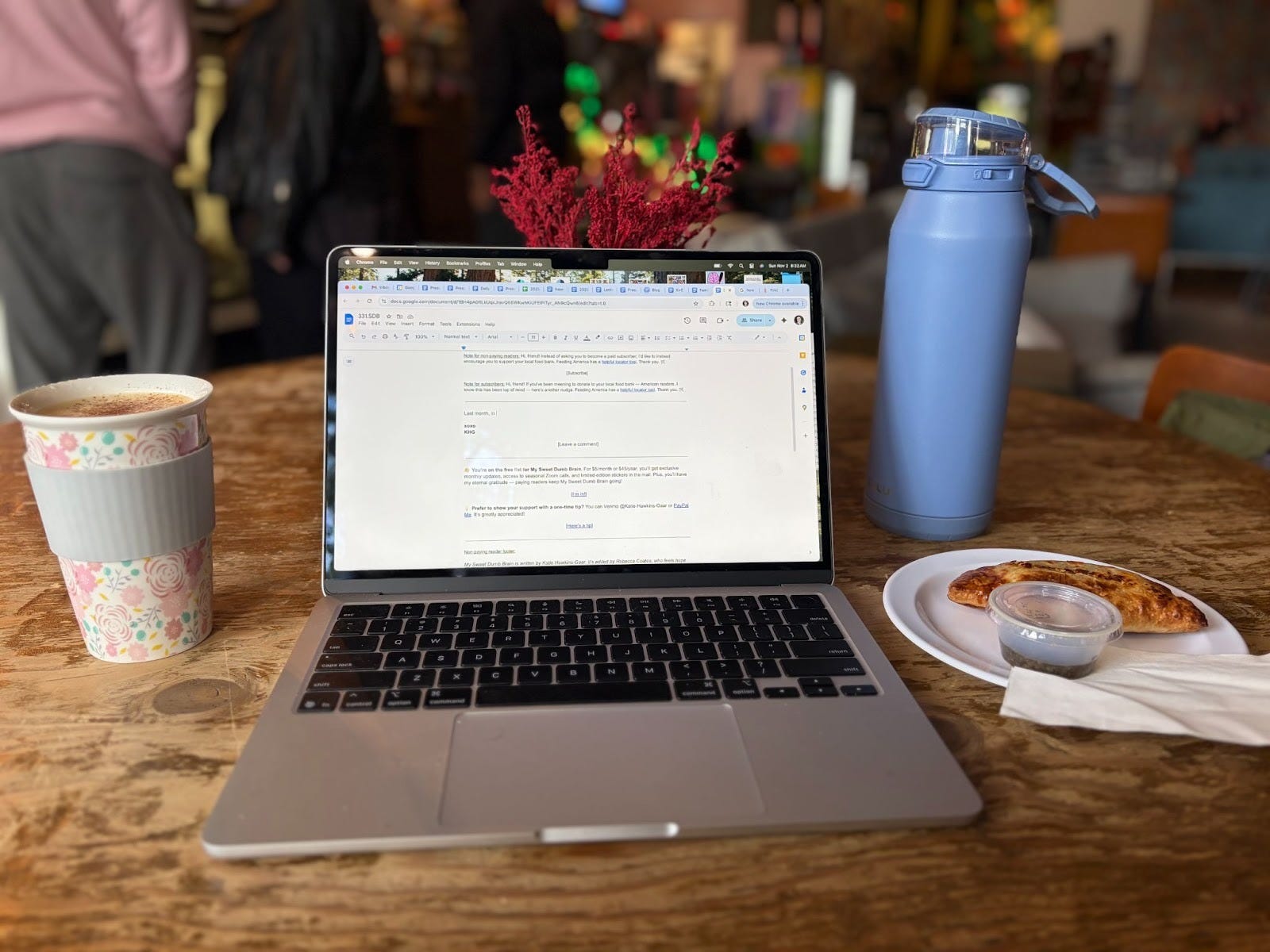
On Sunday, before spending the majority of the day solo parenting, I walked to our neighborhood coffee shop to work on this essay. I’d considered revising the novel instead, but the urgency of my newsletter schedule won out. I told myself I’d return to the novel that evening.
But I didn’t. I was just chapters away from finishing The Plot — a book, fittingly, about a tortured writer — and I couldn’t wait to see how it ended. The best writers are readers, I told myself, hoping it wasn’t a total cop-out.
Without giving too much away (if you like psychological thrillers or enjoyed Yellowface, I think you’ll love this one), the novel takes place in New York, Seattle, and Vermont. Then, in those final chapters I read Sunday evening, the protagonist unexpectedly finds himself in north Georgia.
“He was changing his plans, extending his rental car, and, worst of all, driving north to a place he’d never even heard of before today, in a part of Georgia he’d never had any reason to visit. Until now.”
Where did he wind up? No place other than Clayton, Georgia.
“It really was the middle of nowhere. But it was also pretty. Very pretty and very tranquil and so surrounded by forest he could only imagine what it must be like out here in the dead of night.”
When I find a fortuitous sign, I take it. And the fact that Jean Hanff Korelitz’s propulsive, delightful book — one that reminded me why I love to write — partially takes place in Clayton, of all places, feels like a sign worth paying attention to.
As nice as it would be, I can’t carve out regular three-day retreats. I can’t stop meeting work deadlines or shirk my responsibilities as a parent. And I know that, in order to write, I also need to live — to see friends, to be inspired, to move my body, to rest.
It’s hard to find enough time for it all. I have to make tough decisions. If I want to write a novel I’m proud of, I need to prioritize it, however best I can.
In a 2021 profile, Korelitz recalled her early career struggles. Her first two novels were “rejected everywhere,” she said. Pregnant and convinced she’d never have time to write again, her agent told her, “Maybe, but I have clients who suddenly got very organized when they had children.” Korelitz laughed it off, thinking she wasn’t that type of person. “But it was me,” she said. “I got very organized. Every time I had a babysitter so I could write, I wrote. I didn’t sit around.”
Sometimes, when I’m feeling particularly time-scarce and unsure of my abilities, I wonder if it’s silly to even dream of becoming a published author. To pour so much time into a project with such slim odds of success. But then I read a book like The Plot and feel a jolt of energy. What if I could write something like that, too?
“I never saw myself as a thriller writer,” Korelitz said in another interview. “But life is too short not to have a plot twist in every single book.”
Life is too short not to have plot twists, period. And while I’ve had my share happen to me, I’d love to write one myself.
One of my favorite parts of being in Clayton was the nighttime. Once I got over the unease of being alone, in the middle of nowhere, I reveled in it. Without a television to distract me or chores to check off, I felt soothed by the darkness. My choices were simple: write, read, or sleep. (Or eat even more leftover pasta. Not a great option.)
It feels fitting to reflect on this at the end of daylight saving time. Now, as nightfall comes earlier, ever sneaking up and surprising me, I’m trying to remember what those quiet evenings felt like. To appreciate the time I do have.
It may never be enough, but it’s mine.
xoxo
KHG
I have every confidence you’ll find an agent (and an editor and an audience) for this book eventually!
Three things:
1. This book will be what it's meant to be. It already is! I cheered that you still love it. ✨ And so it is ✨
2. I found myself, in the absence of being able to tell you how to make more time, truly reveling at how rich and vibrant a life you're living, a puzzle of many pieces, all vital.
3. Oliver Burkeman, always, on these kinds of musings. What if you never make more time? What if this book is the work of an entire lifetime? What if you never figure it out? https://www.oliverburkeman.com/never
Okay a fourth thing: I adore you and am cheering you on, however fast, however slow, whatever outcome.